AI in Federal Hiring: What OPM’s New Guidance Means for Agencies, Leaders, and Federal Job Seekers
Artificial intelligence is moving deeper into the federal workforce, and its growing role now extends to one of government’s most consequential responsibilities: hiring the people who carry out the mission.
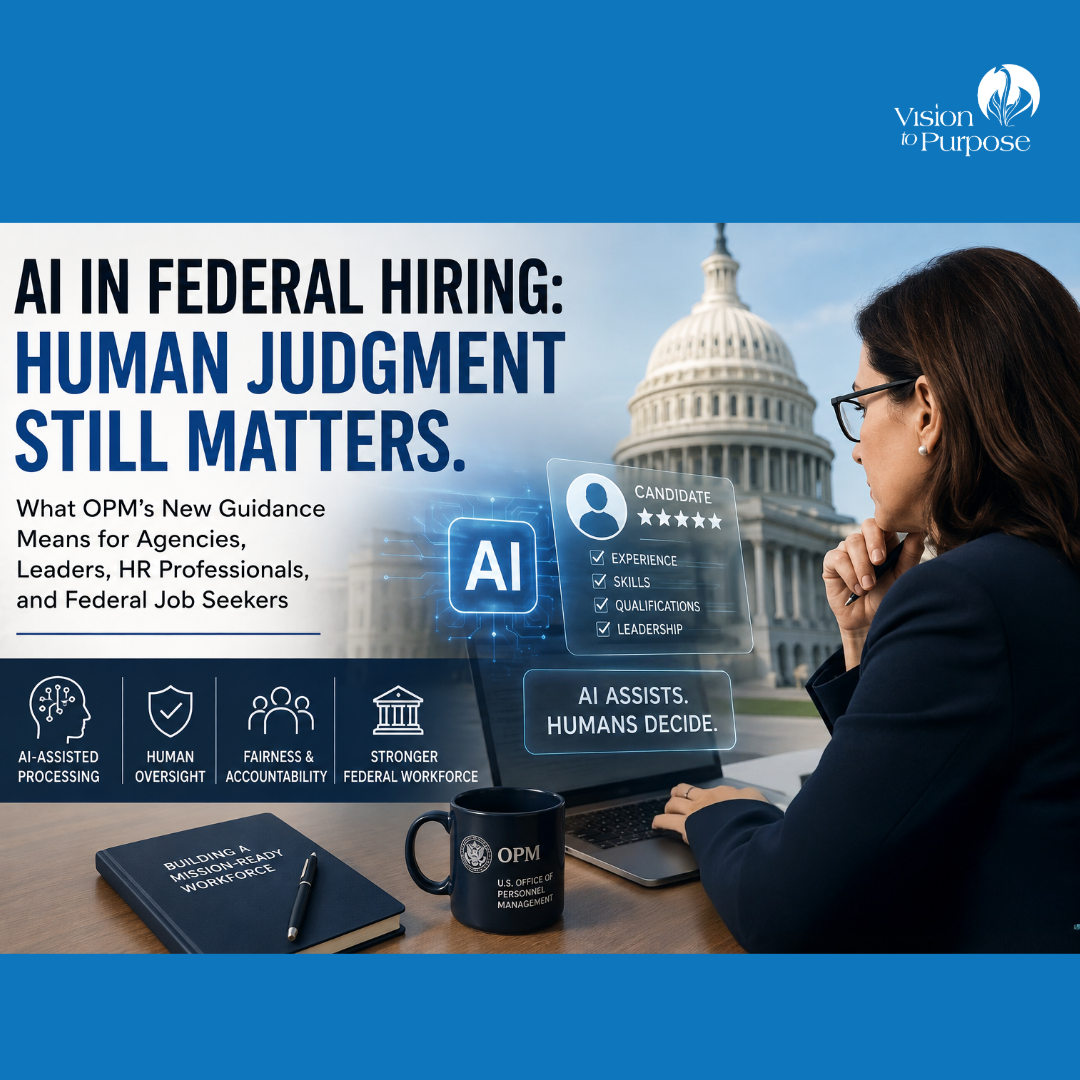
On August 27, 2026, the U.S. Office of Personnel Management issued governmentwide guidance on the use of artificial intelligence in the federal hiring process. The guidance provides agencies with greater clarity about how AI may support hiring activities while reinforcing an essential principle. As technology assumes a larger role in evaluating information and supporting decisions, human oversight and accountability remain critical.
The development matters well beyond the federal human resources community. Federal leaders continue to face pressure to recruit qualified talent faster, improve the applicant experience, reduce administrative burden, and compete for people with critical skills. AI offers opportunities to support each of these objectives, but greater technological capability does not remove the responsibility associated with making decisions about people.
Federal hiring therefore provides a timely example of a much larger challenge confronting organizations across government and industry. The question is no longer simply whether organizations will use AI. Leaders must now determine whether their people, policies, workflows, and decision-making practices are prepared to use it responsibly.
Why AI in Federal Hiring Matters
Federal hiring has long been associated with complex processes and lengthy timelines. According to OPM, the federal government’s average time-to-hire is approximately 87 days, while the Merit Hiring Plan maintains an 80-day target. Improving the process is more than an administrative concern. Vacancies in critical positions can affect organizational capacity, workforce continuity, and mission performance.
AI creates an opportunity to reduce some of the administrative burden associated with federal hiring. OPM’s new guidance gives agencies a clearer framework for considering AI across the hiring lifecycle, including uses that may help professionals review information, identify relevant qualifications, process documentation, and support other hiring activities.
OPM has also indicated that new AI capabilities are coming to USAJOBS, USA Staffing, and USA Hire. These capabilities are expected to include improvements to search, job titles, job descriptions, and other parts of the federal hiring experience.
The potential for greater efficiency is significant, but speed cannot become the only measure of success. Federal agencies must also protect the accuracy, fairness, transparency, and defensibility of employment decisions. Processing information more quickly provides little benefit if an organization reaches a poor decision more efficiently.
AI Can Support a Hiring Decision Without Owning It
One of the most important distinctions in OPM’s guidance is the difference between using AI to assist human decision-making and allowing technology to become the decision-maker.
An AI-enabled system might help an HR professional identify portions of an applicant’s résumé that appear relevant to minimum qualifications. The technology can help locate and organize information, but the responsible official must still evaluate the applicant’s underlying experience and make the appropriate determination.
This distinction becomes increasingly important as AI systems grow more sophisticated. AI-generated analysis can appear polished, comprehensive, and authoritative, which may encourage users to place greater confidence in the output than the underlying evidence warrants. A professional presentation, however, is not evidence of accuracy.
Meaningful human oversight requires more than placing a person at the end of an automated process. The individual reviewing the recommendation must possess the knowledge, authority, and confidence to question the output, examine the evidence, identify inconsistencies, and reach a different conclusion when appropriate.
Human oversight only works when the human is prepared to exercise judgment.
What AI-Assisted Hiring Requires From Federal Leaders
Federal leaders do not need to become artificial intelligence engineers to lead effectively in an AI-enabled workplace. They do, however, need to understand how AI changes their responsibilities.
Before integrating AI into a consequential workflow, leaders should understand what role the technology is expected to play, what information it evaluates, how its outputs will be validated, and where independent human review is required. Leaders also need clear processes for handling disagreements between human reviewers and AI-generated recommendations.
Accountability must be equally clear. Organizations need to know who has the authority to make the final decision, how decisions will be documented, how potential bias or unintended consequences will be identified, and who remains responsible when an AI-assisted recommendation contributes to an incorrect outcome.
These are not simply technical questions. They are questions of leadership, governance, organizational design, and workforce readiness.
An organization can invest in sophisticated artificial intelligence while remaining poorly prepared to use it.
AI Workforce Readiness Is More Than AI Literacy
AI literacy has become an important workforce priority, and employees need a basic understanding of artificial intelligence, its capabilities, its limitations, and its appropriate uses. Literacy, however, represents only the beginning of organizational readiness.
A workforce can understand AI without being prepared to integrate it responsibly into consequential work.
AI workforce readiness requires employees to understand how AI applies to their roles and managers to understand how AI changes the way work is supervised and evaluated. Leaders must establish decision rights and accountability, while organizational policies need to define acceptable use. Workflows must identify where human review belongs, and training must prepare employees to recognize limitations rather than simply teach them how to operate a tool.
Organizations also need to determine whether AI is improving actual performance. Increased usage does not necessarily indicate successful adoption.
Federal hiring illustrates the difference clearly. An HR professional may know how to operate an AI-enabled system while lacking the knowledge or confidence necessary to evaluate whether its recommendation is appropriate. Effective AI competence therefore requires both technical familiarity and professional judgment.
This challenge extends well beyond hiring. As I discussed in Workforce Problem Hiding Behind Your AI Strategy, organizations can invest heavily in AI while overlooking the workforce strategy required to translate technology into meaningful organizational performance.
Hiring Managers Need the Judgment Advantage
AI has the potential to help hiring professionals process information more efficiently, identify relevant patterns, and focus attention on the evidence most important to a decision. Those capabilities can strengthen human performance, but they can also create a risk of overconfidence.
Consider a hiring manager who receives an AI-assisted recommendation suggesting that one candidate appears more qualified than another. Accepting the recommendation should not be the end of the decision process. The manager still needs to understand the evidence supporting the conclusion and consider whether relevant information may have been overlooked or misunderstood.
The issue becomes particularly important when candidates possess specialized government or military experience that may not translate neatly into conventional terminology. A recommendation can appear reasonable while still missing important context.
Leaders who can interrogate AI-generated recommendations rather than simply accept them possess what I call the Judgment Advantage. It is the ability to use AI to expand analytical capacity without surrendering the discernment, context, ethical reasoning, and accountability required of human leadership.
AI should strengthen judgment, not replace it.
I explore this leadership responsibility more deeply in AI-Supported Decision-Making in Government: 12 Leadership Practices for Better Decisions. The principles that apply to operational, resource, and mission decisions become equally important when technology influences decisions about people.
What Federal Job Seekers Need to Understand
The expansion of AI-assisted federal hiring also has implications for applicants. Candidates should expect technology to become increasingly involved in the systems and processes surrounding federal employment, but this development does not mean applicants should begin writing résumés solely for algorithms.
Clear evidence becomes even more important when both technology and people may review applicant information.
Federal candidates should communicate their qualifications in a way that makes relevant experience easy to understand. Accomplishments should provide appropriate context and results, while leadership responsibilities, technical expertise, decision-making experience, and mission impact should be supported with evidence whenever possible.
Applicants should also connect specialized experience clearly to the requirements of the position. Neither technology nor a human reviewer should be expected to infer qualifications that have not been communicated effectively.
Strong career communication has always required candidates to demonstrate value. AI does not change the principle. It increases the importance of clarity.
Why This Matters for Transitioning Military Members
The implications are particularly important for transitioning service members and veterans seeking federal employment.
Military professionals frequently possess extensive experience in leadership, operations, logistics, cybersecurity, intelligence, acquisition, program management, risk management, training, and other mission-critical functions. Their challenge is rarely a lack of meaningful experience. More often, the challenge involves translating that experience into language another organization can readily understand.
Military terminology, organizational structures, position titles, and mission environments do not always translate naturally into civilian or federal workforce language. AI does not eliminate this challenge because a system cannot reliably give credit for experience it cannot recognize or interpret correctly.
Transitioning service members therefore need to communicate more than their responsibilities. Their career materials should demonstrate the scope and complexity of their work, the decisions they made, the people and resources they led, the problems they solved, and the results they achieved.
Human storytelling remains important in an AI-enabled hiring environment because context gives experience meaning.
Responsible AI Use Applies to Applicants Too
Federal applicants also need to understand the boundaries surrounding their own use of artificial intelligence.
Agencies may use approved AI capabilities to support certain hiring activities, but applicants remain responsible for complying with the rules governing assessments and application processes. OPM specifically states that applicants may not use artificial intelligence tools such as ChatGPT, Claude, or Copilot while completing USA Hire assessments. These assessments are intended to measure an applicant’s independent competencies and must be completed without assistance.
The distinction reinforces an important principle of responsible AI use. Effective adoption does not mean using artificial intelligence for every available task. Responsible users must understand when AI adds value, when human verification is necessary, and when independent human performance is required.
Organizations should approach AI adoption with the same discipline.
Efficiency Cannot Become the Only Goal
Reducing federal hiring timelines is important because mission requirements do not disappear while positions remain vacant. Still, efficiency should not become the sole measure of successful AI implementation.
A hiring process can become faster without becoming better. An organization can process more applications while overlooking qualified candidates, and a manager can receive recommendations more quickly without fully understanding how those recommendations were produced.
Responsible AI adoption therefore requires organizations to evaluate both efficiency and decision quality.
Leaders should examine whether AI improves accuracy, strengthens the applicant experience, reduces administrative burden, produces explainable recommendations, and contributes to better hiring outcomes. They should also track where human reviewers identify errors or override AI-generated recommendations because those instances provide valuable information about how well the system is performing.
The objective should never be automation for its own sake.
The objective is better mission performance.
What OPM’s Guidance Teaches Us About AI Workforce Readiness
Federal hiring provides a useful case study for understanding the broader challenge of organizational AI adoption.
Many organizations begin by providing employees access to AI tools. Employees experiment, useful applications emerge, and productivity may improve in selected tasks. Moving from individual experimentation to organizational capability, however, requires considerably more work.
Leaders must determine how AI fits into established workflows, which roles require new capabilities, where governance is necessary, how managers should supervise AI-enabled work, and how performance will be measured.
One way to think about the progression is:
AI Access → AI Use → AI Workforce Readiness → AI-Enabled Performance → Mission or Business Value
Many organizations have already begun navigating the first two stages. The greater leadership challenge lies in the last three because providing access to technology is relatively easy. Creating sustainable organizational capability is much harder.
I explored this transition in You Adopted an AI Tool. What Comes Next?, where I discuss why organizations need a human strategy alongside their technology strategy.
OPM’s guidance brings the issue into sharper focus because hiring is consequential work. When AI moves into processes affecting people’s careers and organizational workforce decisions, informal experimentation is no longer sufficient.
Organizations need readiness.
The Future of Federal Hiring Is AI-Assisted and Human-Accountable
OPM’s guidance signals an important evolution in federal workforce management. Artificial intelligence will increasingly help agencies perform work that once required significant manual effort, creating opportunities to find information faster, organize complex data, identify relevant experience, and improve administrative processes.
Greater technological capability, however, does not diminish human responsibility. In consequential decisions, it increases the importance of professional judgment.
AI can help leaders see information they may have missed, analyze larger amounts of data, and consider possibilities more quickly. The accountable human decision-maker must still determine whether the evidence is sufficient, whether the recommendation makes sense, whether the process is fair, and whether the decision supports the mission.
Leadership accountability cannot be delegated to an algorithm.
The organizations best positioned for the AI era will not necessarily be those with the greatest number of AI tools. Sustainable advantage will belong to organizations whose people understand how to combine technological capability with human judgment.
How Vision to Purpose Helps Organizations Prepare for AI-Enabled Work
At Vision to Purpose, we approach artificial intelligence as a workforce and leadership capability rather than simply a technology implementation.
Organizations need more than employees who know how to operate AI tools. They need leaders and workforces prepared to integrate AI responsibly into decisions, workflows, and mission requirements while maintaining the judgment and accountability required for effective execution.
Vision to Purpose helps government agencies and organizations strengthen these capabilities through AI workforce readiness assessments, AI-supported decision-making programs, leadership development, executive briefings, facilitated workshops, executive and leadership coaching, workforce strategy, change management, and customized government training.
Our work connects AI capability with the human judgment, leadership readiness, workforce preparation, and organizational discipline required to translate technology into performance.
The objective is not to turn every employee into an AI expert. The objective is to prepare people to work effectively with AI, think critically about its outputs, make sound decisions, and remain accountable for the results.
Ready to strengthen your organization’s AI workforce readiness? Contact Vision to Purpose to discuss an executive briefing, workforce readiness assessment, leadership development program, or customized government training engagement.
Frequently Asked Questions
Can federal agencies use AI when hiring employees?
Yes. OPM’s August 27, 2026 guidance provides federal agencies with direction for evaluating and using AI to support appropriate activities throughout the hiring lifecycle. Agencies remain responsible for applying appropriate human oversight, governance, and accountability.
Can AI decide whether a federal applicant is qualified?
AI may assist professionals with reviewing and organizing information relevant to qualification requirements, but consequential personnel decisions require appropriate human involvement. Responsible officials must evaluate the underlying evidence and remain accountable for the decision.
Will AI replace federal hiring managers or HR specialists?
AI is more likely to change portions of their work than eliminate the need for human expertise. Administrative and analytical activities may become increasingly AI-assisted, while professional judgment, validation, applicant communication, policy interpretation, exception handling, and accountability remain important human responsibilities.
Should federal applicants write their résumés for AI?
Federal applicants should write clearly for both human and technology-assisted review. Qualifications, experience, accomplishments, leadership responsibilities, and results should be easy to identify and understand. Candidates should avoid relying on keyword stuffing or assuming technology can infer experience that has not been communicated.
Can applicants use ChatGPT or other AI tools during USA Hire assessments?
No. OPM prohibits applicants from using artificial intelligence tools such as ChatGPT, Claude, or Copilot while completing USA Hire assessments. Applicants must complete these assessments independently.
How does AI-assisted federal hiring affect veterans and transitioning service members?
Clear translation of military experience becomes especially important when technology assists with portions of the hiring process. Veterans and transitioning service members should communicate their qualifications, leadership experience, scope of responsibility, accomplishments, decision-making experience, and mission impact in language that both human reviewers and technology-assisted processes can readily understand.
What does AI workforce readiness mean?
AI workforce readiness describes an organization’s ability to integrate artificial intelligence responsibly into work. Readiness extends beyond AI literacy and includes employee capability, leadership alignment, governance, role-specific training, workflow integration, human oversight, decision-making, change management, and performance measurement.
Why is human judgment important when organizations use AI?
AI can analyze information, identify patterns, and generate recommendations, but accountability remains a human responsibility. Leaders must evaluate context, uncertainty, consequences, ethics, competing priorities, and mission requirements when making consequential decisions.
About Dr. Jeannine Bennett and Vision to Purpose
 Dr. Jeannine Bennett is an AI workforce strategist, leadership expert, executive coach, professor, author, and former strategic advisor to senior government leaders. She is the Founder and CEO of Vision to Purpose, LLC, an SBA-certified Woman-Owned Small Business and Virginia SWaM-certified firm that helps government agencies, organizations, and leaders prepare for what is next.
Her professional background spans organizational change, technology implementation, workforce strategy, leadership development, government operations, higher education, executive coaching, military transition, and career strategy. This combination allows her to approach AI workforce readiness from both sides of the equation: helping organizations prepare to use AI responsibly while helping people develop the capabilities needed to succeed as work changes.
Dr. Bennett previously served as Director of the Commander’s Action Group at Navy Expeditionary Combat Command, where she advised senior Navy leaders. She also worked as a strategy and organization consultant with Booz Allen Hamilton, supporting government clients and major technology initiatives.
Through Vision to Purpose, she provides AI workforce strategy, AI-supported decision-making programs, leadership development, executive coaching, government training and facilitation, organizational development, workforce transformation, career and military transition strategy, and speaking and media expertise.
Related Articles
Continue exploring how artificial intelligence is reshaping leadership, workforce strategy, decision-making, and organizational performance: