
Why Most Organizations Miss the Most Critical Step
Many organizations invest in AI tools that remain underutilized.
Not because the technology is flawed. Not because the vendor overpromised. And not because the team isn’t capable.
The real reason is simpler, and more fixable: the people strategy was never built.
This problem is not new. In 2012, my doctoral dissertation examined exactly this pattern, exploring how change management strategies influence the success or failure of technology adoption inside organizations. Fourteen years ago, long before artificial intelligence entered the mainstream conversation, the research confirmed what I have continued to observe in every technology shift since: the technology itself is rarely the problem. What happens to the people around it almost always is.
We are watching that same dynamic play out right now with AI, just at a faster pace and with higher stakes.
The Adoption Gap Is Real, and It’s Growing
In the past 18 months, organizations of every size have rapidly implemented AI tools: unclassified platforms, secure cloud-based AI, productivity assistants, and workflow automation. The enthusiasm has been genuine. The intent has been right.
Even so, most organizations have approached AI adoption as a technology deployment rather than a workforce transformation.
The typical sequence looks like this: the tool is announced, a demonstration is held, a lunch-and-learn is scheduled, and then operations resume as normal. Leadership assumes adoption will follow naturally.
It rarely does.
What follows instead is quiet underuse. Employees default to familiar workflows because the new ones feel uncertain. Senior leaders hesitate to model new behaviors out of concern for appearing unprepared in front of their teams. Middle managers do not reinforce adoption because no one clearly defined what success looks like in their lane.
I saw this play out at a mid-sized organization that rolled out an AI-powered document analysis tool to support its proposal teams. Despite genuine early enthusiasm, usage data revealed that most team members continued working the way they always had. A few supervisors admitted they avoided using the tool in meetings, worried about making mistakes in front of their peers. Without a clear structure for sharing experiences or working through common challenges, adoption stalled quickly, and the technology that was supposed to accelerate delivery operated at a fraction of its potential.
This is the Adoption Gap. In high-stakes environments, where the margin for wasted capacity is thin, it is an expensive problem.
What’s Actually Missing
The missing step is not more training videos, a better user manual, or even a stronger technology selection.
What is missing is a human strategy.
A human strategy is an intentional approach that accounts for the needs, roles, concerns, and capabilities of your people at every stage of AI adoption, not just the deployment phase. It means ensuring leaders are equipped to model new ways of working, that employees receive training relevant to their specific roles, and that open channels exist for two-way communication that make change sustainable.
To help organizations close the gap, here are three practical actions leaders can implement right away.
First, build a core group of early adopters. Identify leaders or team members who are willing to lean in early and hold brief weekly sessions to practice new workflows together. Their firsthand experience becomes a credible model for the rest of the team, because it comes from peers, not from a policy memo.
Second, deliver role-specific training rather than one-size-fits-all sessions. Develop quick-start guides or focused mini-sessions customized to different functions, so every employee can see direct relevance to their daily work. A writer, an engineer, and a program manager all use AI differently. Training should reflect that reality.
Third, create an open feedback channel. Establish a dedicated space, whether a Slack channel, a standing meeting, or a shared document, where employees can raise concerns and ask questions, and where leaders respond promptly. Two-way communication is not a soft nice-to-have. It is the mechanism that surfaces problems before they harden into permanent habits.
A human strategy also means measuring what matters. The most actionable indicators are employee retention on teams affected by new tools, AI usage rates by role, and the speed and quality of key deliverables. These three metrics keep attention where it belongs: on people, performance, and real outcomes, not just login statistics.
Beyond metrics, a human strategy answers the questions that technology vendors rarely ask.
Which roles stand to gain the most from AI, and have those employees been shown specifically how to use it? What behaviors do leaders need to model, and do they feel prepared to model them? Where does AI adoption create anxiety, and how is that being addressed before it quietly undermines the whole effort? How is success being defined, not in clicks and platform usage, but in outcomes that matter to the business? And what happens to the people whose workflows change most significantly? Are they treated as partners in the transition, or as passengers along for the ride?
These are not peripheral questions. In any mission-critical environment, they determine whether a technology investment compounds over time or quietly flatlines.
The Human-in-the-Loop Principle Applies Inside Your Organization Too
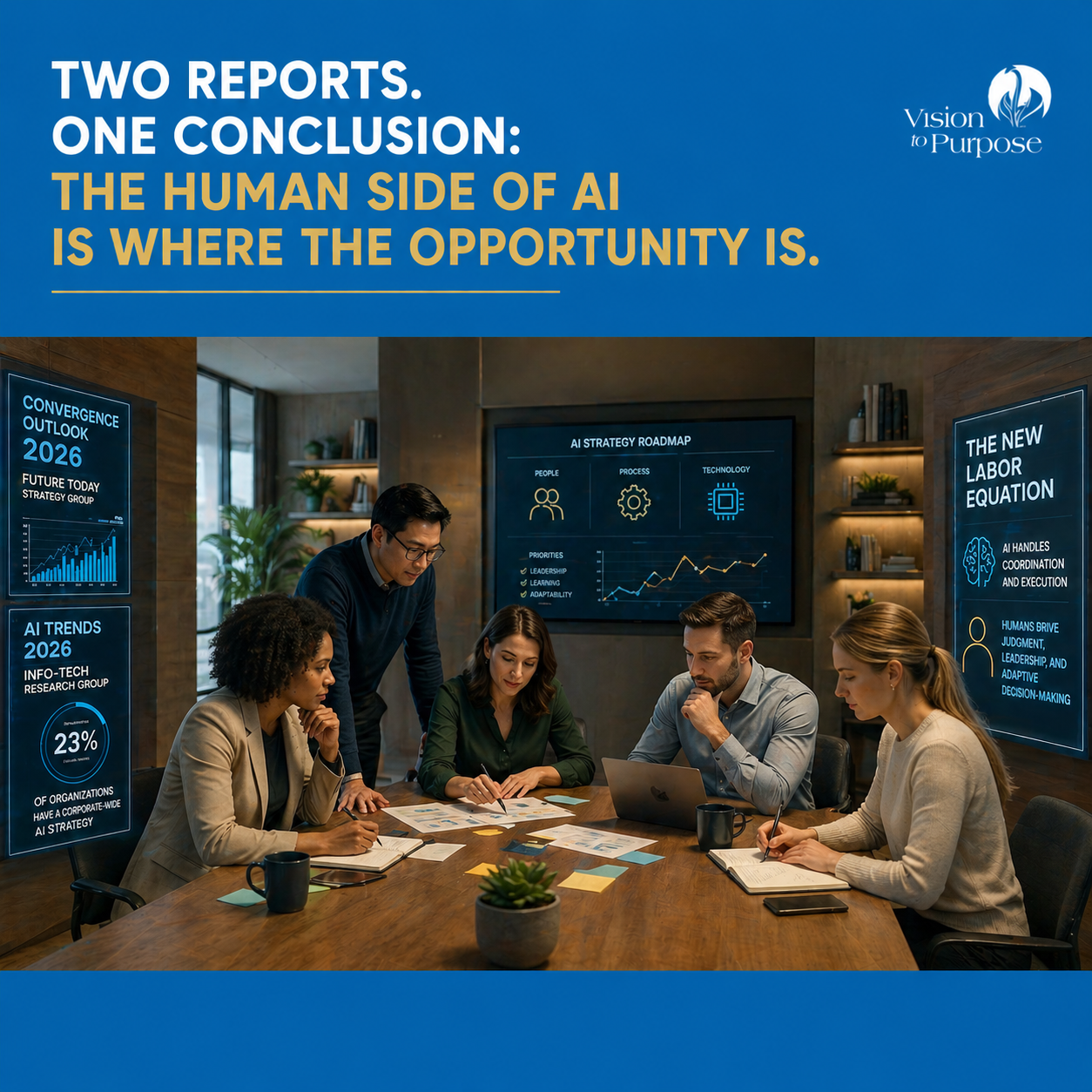
Many industries, particularly those working with AI in high-stakes settings, have embraced the principle of humans in the loop. The idea is straightforward: technology supports human judgment, not the other way around.
The same principle applies to how organizations adopt AI internally.
Your people are not passive participants in your digital transformation. They are the loop. The question is whether you are investing in them as deliberately as you invested in the platform.
The organizations I have seen navigate this well share a few common practices. They treat AI readiness as a leadership competency, not just a technical requirement. They create a culture where people can experiment and learn without fear of criticism. They hold leaders accountable for adoption outcomes, not just deployment milestones, by integrating progress into performance goals and building in regular check-ins to keep expectations clear and measurable.
One organization I am aware of accelerated its AI adoption by forming a small leadership cohort that met monthly. In those sessions, leaders discussed challenges openly, exchanged practical solutions, and shared what was and was not working. Early adopters from different teams were paired with colleagues in similar roles as peer mentors, creating an environment where experimentation was normalized and mistakes were treated as useful data rather than cause for embarrassment. Adoption accelerated not because the technology changed, but because the culture around it did.
The Window Is Now
Organizations that build their human strategy now, while AI adoption is still early enough to be shaped, will hold a meaningful advantage over those that wait until the gaps become visible in performance reviews, deliverable quality, and turnover rates.
Waiting carries real costs. Talented people leave when change feels chaotic and growth feels limited. Business goes to faster, more agile competitors. Delayed adoption leads to rework, missed deadlines, and eroded client confidence. These are not hypothetical outcomes. They are patterns I have observed in organizations that treated workforce transformation as an afterthought.
AI technology is becoming widely accessible. The tools available to large enterprises today will be within reach of smaller organizations within the next 18 months. The differentiator will not be which platform a business chose. It will be how well its people understand, trust, and use that technology, and how effectively its leaders guided them through the change.
It is fundamentally a human challenge. It requires a human-centered solution.
As a starting point, consider bringing your leadership team together within the next two weeks for one focused conversation: where is adoption lagging, and what is genuinely getting in the way? An honest, specific, people-centered discussion is often where the real transformation begins.
What I Would Love to Hear From You
If your organization has implemented AI tools in the past year, I have one question.
What has changed, not in your systems, but in your people?
With purpose,

Dr. Jeannine Bennett is the founder and CEO of Vision to Purpose and a nationally recognized voice on AI workplace strategy, leadership development, and career transformation. She works with organizations navigating the human side of AI adoption and with professionals ready to lead with clarity and purpose in a rapidly changing world of work.
Through Vision to Purpose, Jeannine delivers AI workforce strategy, leadership consulting, career strategy, author mentorship, and professional writing services — all built around one conviction: that the right strategy at the right moment changes everything.
Ready to build a future-ready career or business? Consult with Jeannine.