
Before Investing in AI Training, Is Your Government Workforce Ready?
Artificial intelligence is moving rapidly across the federal government. Agencies are exploring how AI can improve hiring, strengthen decision-making, reduce administrative work, modernize operations, and improve services to the public.
As adoption accelerates, many organizations are moving directly toward tools and training. Leaders purchase licenses, schedule demonstrations, assign introductory courses, and encourage employees to experiment. These activities may increase awareness, but they do not necessarily prepare an organization to use AI responsibly or effectively.
Government organizations should assess workforce readiness before making a major investment in AI training. A readiness assessment helps leaders identify employee skill gaps, leadership alignment, workflow requirements, governance concerns, and barriers to adoption. The findings allow organizations to select training and implementation support based on demonstrated needs instead of assumptions.
AI training matters. However, training delivers its greatest value when leaders first understand what employees need to learn, how AI will support the mission, and what organizational conditions must exist for adoption to succeed.
Why AI Workforce Readiness Matters for Government
AI adoption is not solely a technology initiative. It is a workforce and leadership transformation.
The Office of Management and Budget’s guidance on federal AI use calls for agencies to promote innovation and responsible adoption while maintaining appropriate safeguards. The guidance emphasizes governance, accountability, risk management, and public trust. These responsibilities cannot be fulfilled by technology teams alone. Leaders, supervisors, employees, acquisition professionals, human resources specialists, legal advisers, and mission owners all have roles in responsible implementation.
The federal government is also investing in employee learning. The Office of Personnel Management has made its 2026 AI Training Series for Government Employees available to help employees build foundational knowledge about the responsible and effective use of AI in government.
Foundational training is a valuable starting point. Individual agencies must still determine how general AI knowledge applies to their missions, positions, workflows, risks, and performance expectations.
An employee working in federal hiring may need different competencies than an acquisition professional, intelligence analyst, program manager, human resources specialist, or senior executive. Providing everyone with the same training may build general awareness without producing the role-specific capability required for meaningful adoption.
Why AI Training Alone May Not Solve the Problem
Training is often treated as the solution when the underlying problem has not been clearly defined.
An organization may assume employees need more technical knowledge when the more significant barrier is unclear leadership direction. Employees may understand an AI tool but remain uncertain about whether they are authorized to use it. Leaders may encourage experimentation without identifying acceptable use cases, data restrictions, review requirements, or accountability expectations.
In other situations, employees may complete training but return to workflows that have not been redesigned to incorporate what they learned. Without a connection to actual work, even excellent training can become an isolated learning event.
Government leaders should ask several questions before selecting an AI training program:
- What mission or workforce outcome are we trying to improve?
- Which positions will use AI, and for what purposes?
- What do employees already know?
- What misconceptions or concerns are affecting adoption?
- Which tasks require human judgment and accountability?
- What policies and safeguards govern employee use?
- How will employees apply the training to their daily responsibilities?
- How will the organization measure readiness, adoption, and results?
Training becomes more valuable when the answers shape its content and delivery.
Five Signs Your Government Workforce Is Not Ready for AI
1. Leaders Have Not Defined the Intended Outcomes
Organizations sometimes begin with a tool instead of a mission need. Employees are introduced to a platform without understanding what problem it should solve or what result the organization expects.
A clear AI use case should connect technology to an operational, workforce, or mission outcome. Faster work alone is not always the right measure. Leaders may also need to consider quality, accuracy, consistency, accessibility, risk, employee capacity, and service to the public.
Leaders should be able to explain why AI is being introduced, where it may provide value, and where human responsibility must remain central.
2. Employees Do Not Understand How AI Affects Their Roles
General AI awareness does not automatically translate into job readiness.
Employees need role-specific guidance about how AI may change their tasks, decisions, required competencies, and professional responsibilities. Some employees may need to use AI tools directly. Others may need to evaluate AI-supported recommendations, oversee vendors, protect information, redesign workflows, or supervise employees using AI.
Uncertainty about job impact can also create hesitation or resistance. Workforce communication should address both capability and trust. Employees need honest information about what is changing, what is not changing, and how the organization will support them.
3. Training Is Not Connected to Government Workflows
Employees learn best when training reflects the work they are expected to perform.
A broad course may explain generative AI, prompt development, limitations, and risk. Role-based development goes further by allowing employees to practice with realistic government scenarios, appropriate information, and clearly defined boundaries.
Training should help employees answer practical questions:
- When is AI appropriate for this task?
- What information may be entered into an approved system?
- How should AI-generated content be reviewed?
- When must an employee disclose or document AI use?
- Which decisions require additional oversight?
- Who remains accountable for the final result?
AI literacy provides a foundation. Workflow-based learning turns that foundation into performance.
4. Governance and Accountability Remain Unclear
Employees may hesitate to use AI when organizational guidance is incomplete. Others may use it inconsistently or take unnecessary risks.
The NIST AI Risk Management Framework provides a structured approach for helping organizations govern, map, measure, and manage AI-related risks. The framework emphasizes that risk management should be continuous and connected to the context in which an AI system is used.
Government organizations need more than a policy stored on an internal website. Employees must understand how governance applies to their responsibilities. Leaders must also establish clear ownership for approving use cases, managing risk, monitoring performance, responding to problems, and maintaining human accountability.
Responsible adoption becomes part of the organizational culture when expectations are visible, understandable, and reinforced through leadership behavior.
5. The Organization Cannot Measure Adoption or Readiness
Course completion is not the same as workforce readiness.
A completion report can show that employees attended training. It does not reveal whether they can apply what they learned, recognize limitations, exercise sound judgment, or improve mission performance.
Meaningful measures may include:
- Employee confidence and demonstrated competence
- Ability to identify appropriate and inappropriate AI use cases
- Application of AI within approved workflows
- Quality and accuracy of AI-supported work
- Compliance with review and documentation requirements
- Time saved without sacrificing accountability
- Improvements in service, decision quality, or operational performance
- Leadership confidence in organizational controls
Measurement should begin before training so leaders can compare initial conditions with later results.
What an AI Workforce Readiness Assessment Should Examine
An effective AI workforce readiness assessment examines the organization as a connected system. Technology is one part of that system, but leadership, people, governance, culture, workflow, and measurement also influence the outcome.
The assessment should help leaders understand:
- Whether AI priorities are connected to mission outcomes
- Whether leaders share a consistent vision for adoption
- Whether employees possess the necessary foundational and role-specific competencies
- Whether organizational policies are understood and usable
- Whether workflows are prepared for responsible AI integration
- Whether employees trust the implementation process
- Whether managers can guide performance in an AI-enabled environment
- Whether the organization can measure adoption, risk, and results
A readiness assessment should not become an extended exercise that delays action. Its purpose is to give leaders enough evidence to make better decisions about training, implementation, and workforce investment.
How Readiness Findings Improve Training and Implementation
Readiness findings allow an organization to replace a one-size-fits-all training plan with a targeted workforce strategy.
One group may need foundational AI literacy. Another may need scenario-based instruction related to its occupational responsibilities. Supervisors may need guidance on leading employees through changing workflows. Senior leaders may require executive briefings focused on governance, investment decisions, risk, and organizational accountability.
The assessment may also reveal that training is not the first priority. An organization may need to clarify policy, define approved use cases, strengthen communication, establish governance responsibilities, or redesign a process before employees can apply new skills effectively.
A short assessment can help determine whether the next investment should focus on:
- Leadership alignment
- Foundational AI literacy
- Role-based workforce development
- Responsible-use guidance
- Workflow redesign
- Change communication
- Governance and accountability
- Pilot implementation
- Measurement and continuous improvement
This approach protects limited resources by directing funding toward the organization’s most important readiness gaps.
What Government Leaders Should Do Before Selecting AI Training
Government leaders do not need to wait until every question has been answered. They do need a clear starting point.
First, define the mission or workforce problem. Identify the result the organization needs rather than beginning with a preferred tool or course.
Second, examine workforce readiness. Determine what leaders and employees know, where uncertainty exists, and what may prevent responsible adoption.
Third, segment the workforce. Different roles require different levels of knowledge, practice, oversight, and decision authority.
Fourth, connect training to approved use cases and real workflows. Employees should understand how learning applies to their responsibilities.
Fifth, establish measures before implementation. Leaders should know how they will evaluate capability, adoption, risk, and mission value.
These actions make AI training more relevant, defensible, and useful.
From AI Readiness to Mission Results
Government AI adoption will not succeed because employees complete one course or receive access to a new platform. Sustainable adoption requires leaders who provide direction, employees who understand their responsibilities, workflows that support appropriate use, and governance that protects the mission and the public.
My work across government, leadership development, workforce strategy, higher education, and AI adoption has reinforced an important lesson. Technology implementation is rarely only a technology problem. Leaders must prepare people to understand new expectations, exercise sound judgment, adapt workflows, and remain accountable for mission outcomes.
As I explained in AI-Supported Decision-Making in Government: 12 Leadership Practices for Better Decisions, AI can support analysis and improve access to information, but leaders remain accountable for the decisions made with its assistance.
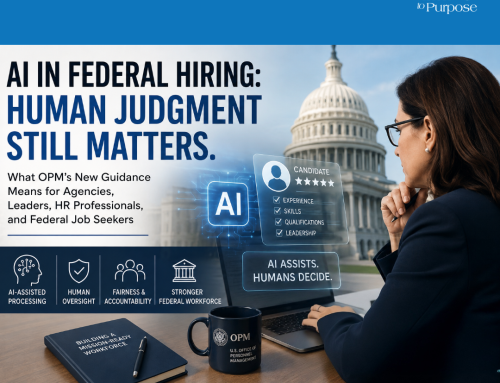
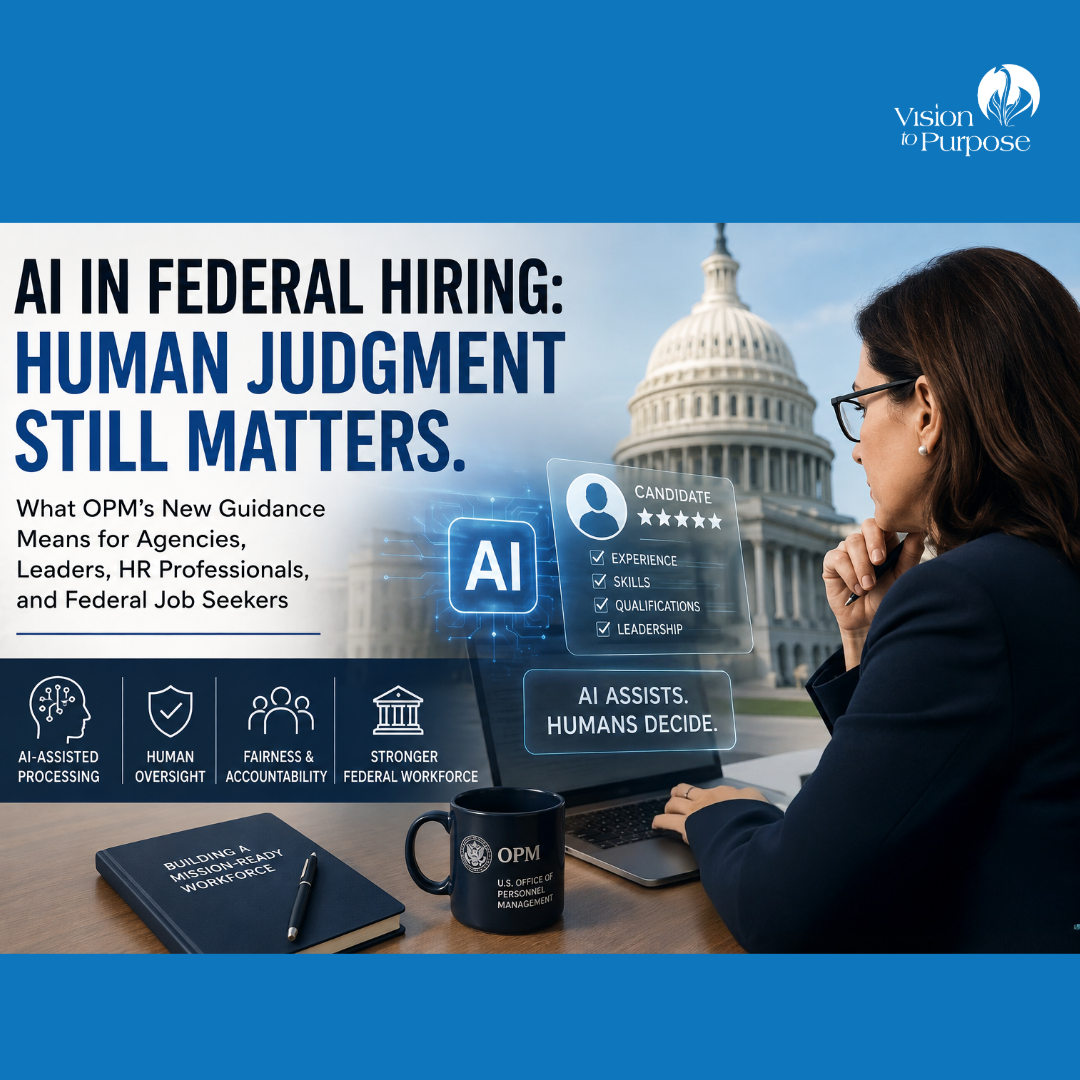
Recent OPM guidance on using AI in federal hiring provides another practical example. Agencies can use AI to improve hiring efficiency, but technology must operate within clear requirements for oversight, documentation, fairness, and human judgment.
The workforce is where policy, technology, leadership, and mission execution meet. Preparing that workforce is not a secondary implementation activity. It is central to achieving responsible, measurable results.
How Vision to Purpose Supports Government AI Workforce Readiness
At Vision to Purpose, we approach artificial intelligence as a workforce and leadership capability rather than simply a technology implementation.
Government organizations need more than employees who understand how to operate AI tools. They need leaders and workforces prepared to integrate AI responsibly into decisions, workflows, and mission requirements while maintaining the judgment and accountability required for effective execution.
Vision to Purpose helps government agencies, government contractors, and organizational leaders strengthen these capabilities through:
- AI workforce readiness assessments
- Executive briefings
- Leadership development
- Role-based AI workforce training
- Facilitated workshops
- AI-supported decision-making programs
- Workforce strategy
- Change management
- Customized government training and curriculum development
Our human-centered approach examines the organizational conditions that influence readiness, including leadership alignment, workforce capability, governance, communication, workflow integration, and performance measurement.
The VISION Framework™ provides a structured approach to preparing leaders, workforces, and organizations for an AI-enabled environment.
The objective is not to turn every employee into an AI expert. The objective is to prepare people to work effectively with AI, think critically about its outputs, make sound decisions, and remain accountable for the results.
Ready to strengthen your organization’s AI workforce readiness? Contact Vision to Purpose to discuss an AI Workforce Readiness Snapshot, executive briefing, leadership-development program, or customized government training engagement.
Frequently Asked Questions
What is AI workforce readiness?
AI workforce readiness describes an organization’s ability to integrate artificial intelligence responsibly into its work. Readiness includes leadership alignment, employee capability, governance, role-specific training, workflow integration, human oversight, change management, and performance measurement.
Why should government organizations assess workforce readiness before purchasing AI training?
A readiness assessment helps leaders identify the organization’s actual capability gaps before selecting training. Without this information, an agency may invest in broad AI instruction when its more immediate need involves leadership alignment, role-specific guidance, governance, workflow redesign, or change communication.
What is the difference between AI literacy and AI workforce readiness?
AI literacy provides employees with a basic understanding of artificial intelligence, including its capabilities, limitations, risks, and appropriate uses. AI workforce readiness goes further by preparing employees and leaders to apply AI within specific roles, workflows, policies, and mission requirements.
Does an AI workforce readiness assessment replace employee training?
No. A readiness assessment helps an organization determine what type of training is needed, who needs it, and how it should connect to mission responsibilities. The findings can make subsequent training more focused, relevant, and measurable.
What should an AI workforce readiness assessment examine?
An effective assessment should examine leadership alignment, workforce capability, employee confidence, role requirements, governance, communication, workflow integration, organizational culture, change readiness, and performance measurement. The assessment should also consider whether the organization has defined clear outcomes for AI adoption.
How can government contractors use an AI workforce readiness assessment?
Government contractors can use a readiness assessment to evaluate their own employees, support workforce transformation initiatives, or strengthen solutions delivered to government customers. A focused assessment can also help contractors identify appropriate training, change-management, leadership-development, and implementation requirements.
How can government leaders measure AI workforce readiness?
Leaders can examine employee knowledge, demonstrated competence, confidence, role-specific application, compliance with governance requirements, quality of AI-supported work, workflow adoption, and mission results. Course completion may be one measure, but it should not be treated as proof of readiness.
Why is human judgment important in government AI adoption?
AI can organize information, identify patterns, and generate recommendations, but it cannot assume leadership accountability. Government professionals must evaluate context, evidence, uncertainty, consequences, policy requirements, and mission priorities before acting on AI-supported information.
About Dr. Jeannine Bennett and Vision to Purpose
 Dr. Jeannine Bennett is an AI workforce strategist, leadership expert, executive coach, professor, author, and former strategic advisor to senior government leaders. She is the Founder and CEO of Vision to Purpose, LLC, an SBA-certified Woman-Owned Small Business and Virginia SWaM-certified firm that helps government agencies, organizations, and leaders prepare for what is next.
Her professional background spans organizational change, technology implementation, workforce strategy, leadership development, government operations, higher education, executive coaching, military transition, and career strategy. This combination allows her to approach AI workforce readiness from both sides of the equation: helping organizations prepare to use AI responsibly while helping people develop the capabilities needed to succeed as work changes.
Dr. Bennett previously served as Director of the Commander’s Action Group at Navy Expeditionary Combat Command, where she advised senior Navy leaders. She also worked as a strategy and organization consultant with Booz Allen Hamilton, supporting government clients and major technology initiatives.
Through Vision to Purpose, she provides AI workforce strategy, AI workforce readiness assessments, AI-supported decision-making programs, leadership development, executive coaching, government training and facilitation, organizational development, workforce transformation, career and military transition strategy, and speaking and media expertise.
Related Articles
Continue exploring how artificial intelligence is reshaping government leadership, workforce strategy, decision-making, and organizational performance: